
Python bytecode decompiler
pylingual: CPython bytecode decompiler for Python 3.6+
Category: Developer & security tools · Type: Analysis tool
Target: CPython bytecode decompiler for Python 3.6+ · Python
A CPython bytecode decompiler from the University of Texas at Dallas Systems Security Lab, targeting released Python versions from 3.6 onward: it turns .pyc bytecode back into source, with a hosted web service and a local CLI. Design and evaluation are described in the authors’ IEEE S&P 2025 paper; those results are not treated here as independently re-run.
Relationship
Independent reimplementation
Evidence scope
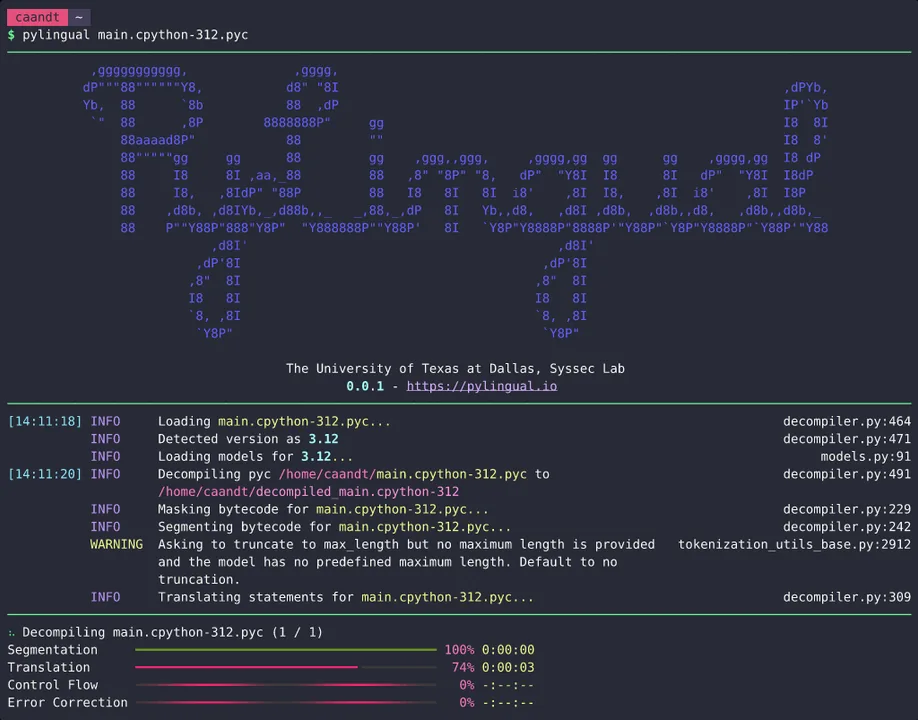
Upstream README describes local uv install and CLI use, support for Python 3.6+ (pyenv for 3.6/3.7), an optional Redis translation-model cache, and a warning that the public codebase is optimized for readability and may differ in control-flow accuracy from the web service. The repository also links the paper and the https://pylingual.io/ homepage. No REA involvement is claimed.
Know before you try
A local run needs uv (and pyenv for EOL 3.6/3.7). Decompilation uses a translation model; first uncached runs perform model inference, and Redis caching is optional. The README warns that the published tree may regress in control-flow accuracy versus the hosted service. Paper metrics and web-service quality are upstream’s. We have not independently tested it.
Status
Active (default branch main); latest release v0.1.0
License
GPL-3.0
GPL-3.0 covers this project. The tool decompiles user-supplied bytecode; it does not ship those inputs. Third-party Python program IP stays with its owners. Translation models and any bundled or downloaded model weights may carry separate terms not restated here.
Source checked