
Symbolic-execution decompiler
Ouroboros: Recover high-level structure from PE binaries in Rust
Category: Developer & security tools · Type: Analysis tool
Target: PE32 / PE32+ binaries · Rust
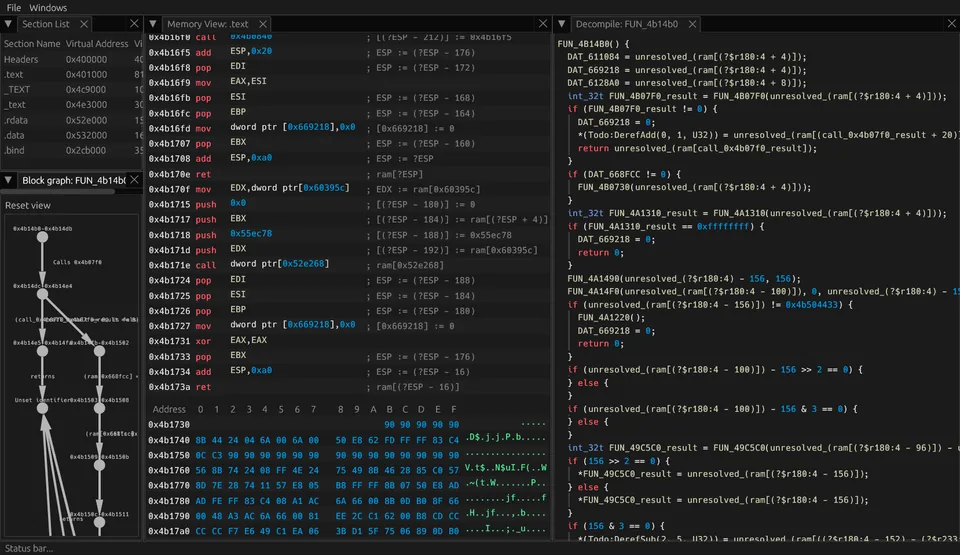
A research-friendly decompiler written in Rust. The README describes it as recovering high-level structure from binaries using symbolic execution and constraint tracking rather than relying only on SSA IR models (it can also ingest SSA IR). It emphasizes block pre/post conditions, register and memory deltas, dominator and post-dominator analysis, and structured reconstruction of if/else, loops, and SESE regions. A GUI built with egui lets the user open a PE32/PE32+ binary, disassemble from a known function start, then decompile a function by symbolically executing it. The README currently says no automated analysis is available: the user navigates to a known function start, presses D to disassemble, then presses F to decompile.
Relationship
Independent reimplementation
Evidence scope
Upstream README describes Ouroboros as a research-friendly Rust decompiler that recovers high-level structure with symbolic execution and constraint tracking, with a manual PE32/PE32+ GUI workflow. No REA involvement is claimed.
Know before you try
The README says automated analysis is not available yet, and the current workflow is manual disassembly then decompilation of a known function in a PE32/PE32+ binary. Capability claims are upstream's; not personally verified beyond public README/LICENSE. We have not independently tested it.
Status
Maintained (not archived); tip pushed 2025-12-02; ~264★
License
MIT OR Apache-2.0
MIT or Apache-2.0, at the user's option, covers this project. The decompiler analyzes user-supplied binaries (currently PE32/PE32+); it does not ship those targets. Analyzed programs stay under their owners' terms.
Source checked